Placenta Encapsulation: What Science Says, Why Families Choose It, and How It May Support Postpartum Recovery
Placenta Encapsulation
What Science Says, Why Families Choose It, and How It May Support Postpartum Recovery
After your baby is born, one incredible organ has completed its work.
For nearly 40 weeks, your placenta nourished your baby by delivering oxygen, nutrients, hormones, and immune protection. It supported every stage of fetal development and helped sustain your pregnancy.
Once your baby is born, most hospitals treat the placenta as medical waste or use it for testing.
Yet for centuries, cultures around the world have viewed the placenta very differently. Many have honored it as a symbol of life and healing. Some families bury it beneath a tree, others preserve it as artwork, and many choose placenta encapsulation as a way to support postpartum recovery.
Today, placenta encapsulation continues to grow in popularity, but many families wonder whether it actually works.
The answer is more nuanced than a simple yes or no.
At Birth You Desire®, we believe every family deserves honest, evidence-based information so they can make the decision that feels right for them.
What Is Placenta Encapsulation?
Placenta encapsulation is the process of turning your placenta into easy-to-take capsules after birth.
After delivery, the placenta is safely collected and prepared using food safety protocols. It is cleaned, dehydrated, ground into a fine powder, and placed into capsules.
For the highest quality preparation, the placenta should ideally be processed within 48 to 72 hours after birth, and most families receive their completed capsules within one week.
Two Methods of Placenta Encapsulation
There are two primary preparation methods.
1- High-Yield (Raw Foods) Method
This method skips the steaming process. The placenta is carefully cleaned, sliced, dehydrated at a low temperature, ground into powder, and encapsulated.
The goal is to preserve as many naturally occurring nutrients and hormones as possible. Families often choose this option when they hope to maximize postpartum energy.
2- Gentle Traditional Chinese Medicine (TCM) Method
This preparation follows traditional Chinese medicine practices. The placenta is gently steamed with lemon and ginger before being dehydrated and encapsulated.
Many parents choose this method because it is believed to promote balance during postpartum recovery. It may also be preferred when there has been mild meconium staining.
Why Do Families Choose Placenta Encapsulation?
The postpartum period is physically and emotionally demanding.
Your body is healing from birth while adjusting to significant hormonal changes, blood loss, interrupted sleep, breastfeeding, and caring for a newborn.
Many families are looking for natural ways to support recovery.
Preparing for birth and feeling unsure about your options? The Birth You Desire doulas support families in Phoenix, Washington, DC, and virtually.
What Does the Research Say?
This is where separating science from personal experience becomes important. Currently, there is a lack of high-quality scientific evidence to conclude that placenta encapsulation consistently improves postpartum recovery.
The American College of Obstetricians and Gynecologists (ACOG) states there is insufficient evidence to recommend placenta consumption for medical purposes. Likewise, the Centers for Disease Control and Prevention (CDC) recommends caution because improper preparation may allow harmful bacteria to survive if strict food safety procedures are not followed.
Several small studies have found:
Small amounts of hormones remain after encapsulation.
Iron levels may increase slightly, but not enough to replace prescribed supplementation.
Researchers have not consistently demonstrated improvements in mood, energy, or milk supply when compared with a placebo.
This does not mean placenta encapsulation is ineffective. It means that larger, higher-quality studies are still needed before medicine can make definitive recommendations.
What Families Report
Science is only one part of evidence-based care. Patient experience also matters.
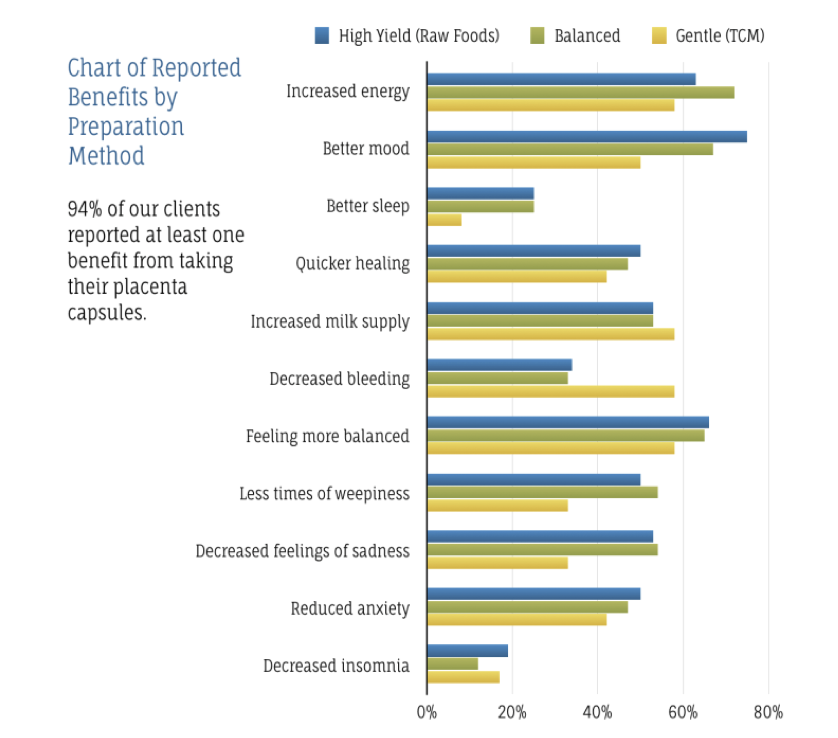
According to our client survey data, 94% of clients reported experiencing at least one benefit after taking their placenta capsules.
The most commonly reported benefits included:
Increased energy
Better mood
Feeling more balanced
Increased milk supply
Faster healing
Reduced anxiety
Less sadness
Fewer episodes of weepiness
Better sleep
Reduced postpartum bleeding
The accompanying chart also compares reported outcomes among High Yield (Raw Foods), Balanced, and Gentle (TCM) preparation methods, showing positive experiences across all three approaches.
While these are self-reported experiences rather than randomized clinical trials, they help explain why many families continue to choose placenta encapsulation.
Why Might Some Parents Feel Better?
Researchers have proposed several possible explanations.
An encapsulated placenta may contain:
Iron
Trace minerals
Small amounts of hormones
Amino acids
Bioactive compounds
It is also important to recognize that parents who choose placenta encapsulation often invest heavily in their postpartum recovery by prioritizing rest, nutrition, hydration, breastfeeding support, and emotional care. These factors may also contribute to better outcomes.
The placebo effect may play a role as well. Placebo responses are genuine biological responses and should not be dismissed. Feeling supported and believing in a treatment can positively influence recovery.
Is Placenta Encapsulation Safe?
Placenta encapsulation is generally considered low risk for healthy individuals when performed by a trained specialist. Our team is certified and uses strict food safety protocols.
However, not every placenta is appropriate for encapsulation. Placenta encapsulation may not be recommended if:
There is a maternal or a placental infection.
There has been significant meconium contamination.
The placenta has been improperly stored.
Medical conditions make encapsulation unsafe.
Always discuss your medical history with both your healthcare provider and your encapsulation specialist.
More Than Capsules
Many families also choose additional keepsakes and preparations.
These include:
Placenta tinctures can be stored for years and traditionally used during future hormonal transitions, such as menopause.
Placenta prints, often called the "Tree of Life."
Smoothie cubes prepared from fresh placenta.
Is Placenta Encapsulation Right for You?
There is no universal answer.
If you are looking for a treatment supported by strong clinical evidence, placenta encapsulation has not yet reached that level of scientific proof.
If you appreciate traditional practices, understand the current research, and work with a qualified professional who follows rigorous safety standards, placenta encapsulation may be a meaningful part of your postpartum recovery. The most important decision is an informed one.
The Bottom Line
Your placenta spent months protecting and nourishing your baby.
Whether you choose to encapsulate it, preserve it as a keepsake, donate it for research, or allow the hospital to dispose of it, there is no right or wrong choice.
At Birth You Desire®, we believe every family deserves compassionate, evidence-based education without judgment. We are here to explain both the science and the tradition so you can confidently decide what is best for your body, your baby, and your postpartum recovery.
If you would like to learn more about placenta encapsulation or reserve this service before your birth, visit BirthYouDesire.com to schedule your free consultation.
References
American College of Obstetricians and Gynecologists. Committee Opinion No. 760: Placenta Consumption.
Centers for Disease Control and Prevention. Notes from the Field: Late-Onset Infant Group B Streptococcus Infection Associated with Maternal Consumption of Placenta Capsules.
Young SM, Gryder LK, Cross CL, et al. Human placenta processed for encapsulation contains modest concentrations of hormones and micronutrients. Placenta.
Farr A, Chervenak FA, McCullough LB, et al. Human placentophagy: A review. American Journal of Obstetrics & Gynecology.
National Institutes of Health. Research on placentophagy and postpartum outcomes.
Birth You Desire doulas have supported thousands of families through pregnancy, birth, and postpartum.
Have Questions About Your Birth Journey? Talk With A Doula.
The Birth You Desire team supports families in Phoenix, Washington DC, and virtually through pregnancy, birth, and postpartum. During a discovery call, we’ll talk about your goals and answer any questions you may have.